Written by Rick Crume, unless otherwise noted
Jump to:
What is a GEDCOM file?
How to open up a GEDCOM file
Sharing a GEDCOM file
Tin you merge files?
Other merging software
7 Steps for Downloading a GEDCOM file from Ancestry.com
How to Consign Your Family Tree GEDCOM Multimedia Files from RootsMagic
Related Reads
You lot've seen information technology mentioned on your favorite websites and in practically every issue of our mag. Thousands of family historians apply it to save and bandy their information. But for many roots researchers, it'southward 1 of genealogy's enduring mysteries. We're talking about GEDCOM, of course—that ubiquitous acronym for GEnealogical Data COMmunications, the standard computer file format family historians utilise to commutation information.
Though most people have little trouble using their genealogy software to enter data and print reports, handling GEDCOMs tin can be intimidating. Fright not: Our primer provides step-by-step instructions for creating and using GEDCOM files.
We've explained what GEDCOM stands for—merely what does it mean for your family history research?
If you lot think of computer file formats as languages, GEDCOM is the one that all genealogy software "speaks." Each family tree programme has its own default file format (chosen a proprietary format), which other software usually can't "translate." But every program tin read and write GEDCOM files, too.
That ways you can share your family unit information with your relatives, even if you lot use different programs. Yous also can contribute your piece of work to online databases such as FamilySearch Memories, or download a young man researcher's data and add together it to your ain family unit file—without retyping anything.
The catch: Because those proprietary formats care for information differently than GEDCOM does, data doesn't transfer perfectly. Some genealogy programs read Family unit Tree Maker (FTM), Personal Ancestral File (PAF) and other file formats directly—no GEDCOM conversion required. That can save time and produce more accurate results, and so see if your software offers this option before using a GEDCOM file.
What is a GEDCOM file?
A: GEDCOM is a figurer file format that lets genealogists swap information about their ancestors. The format'due south compatible with all genealogy software, so no thing what program you use, y'all tin open GEDCOMs created with another program — and other researchers can open up your files.
You lot don't have to buy a GEDCOM, merely you do demand a genealogy program to create or open one. Y'all tin can't use GEDCOMs in other types of software, such as word processors (Give-and-take) or web browsers (Google Chrome). Y'all can get a GEDCOM file several means:
- Create a GEDCOM file of your family data using genealogy software (this is the just way to get a GEDCOM file from your own family unit tree information). The process is piece of cake, but varies slightly depending on your software. In general, you lot'd open the program and pick Export GEDCOM (or a like control) from a menu. Then you'd click through a few dialog boxes that ask yous questions or give instructions.
- Download someone else'southward GEDCOM file from the Internet. Genealogists post their GEDCOMs on websites such as RootsWeb WorldConnect. You can search these sites to find a lucifer for one of your ancestors, and if you do, you tin can download the GEDCOM — with all the family information in the file; not only on the 1 matching person — to your computer. Then you'd utilize your genealogy software to "merge" the data from the GEDCOM into your own family file (after verifying it, of course).
- Share a GEDCOM file the aforementioned mode yous'd share any figurer file — for example, by e-mailing it or saving it to a disk.
Reply provided by Allison Dolan, from the December 2004 event of Family Tree Magazine.
Return to top
How to open up a GEDCOM file
Opening a GEDCOM file is simple. In Windows, just double-click on the file (GEDCOMs accept the file extension .ged, as in smith.ged), and it should open up with your genealogy software. Accept the default file name and location, and your program will "import" the file—basically, it creates a re-create of the GEDCOM file in your software'south proprietary format.
Return to peak
Sharing a GEDCOM file
Just follow these 7 steps to share your GEDCOM file:
1. Locate the file.
Once you've downloaded a GEDCOM file or received one as an e-mail attachment, note its location on your computer'south hard drive or removable drive. You might want to salvage all your GEDCOM files in a folder named GEDCOM.
two. "Postage" the records.
RootsMagic and Legacy Family Tree allow you lot add a source (a person'due south name, address and email address) to each fact in an incoming GEDCOM file and so y'all know where the information came from. If you lot employ a different program, Progeny Software'due south GEDmark can mark the source information on each record in the GEDCOM file before you import it into your family unit file.
3. Select the file.
Get-go your genealogy software and select File>Import File. Locate and select the GEDCOM file, then click OK.
iv. Import the file.
Nigh programs will now enquire you if you want to add the data to your existing file or create a new one. We recommend viewing the new data in a separate file before adding it to your existing family file.
5. Link the multimedia files.
If the GEDCOM'due south creator attached pictures, sound or video, you'll have an extra step: Copy the motion picture files to your computer and make sure the links in your new family file yet point to the pictures. Suppose the sender kept the images on bulldoze C in a folder chosen Genealogy Pictures within the My Pictures folder. The links should work if you lot keep the pictures in an identically named folder at the aforementioned location.
vi. If you click on a link to a picture in PAF and it can't find the image, the program will prompt you lot to locate the file.
Then information technology will ask if you want to change the paths to all the multimedia links in the file to the new path yous specified. Answer "yes." Equally long every bit you kept all the images in the aforementioned folder, the links will be updated correctly.
7. For Family Tree Maker users, it'south better to share FTM files, not GEDCOMs
Family unit Tree Maker's GEDCOMs don't include multimedia links, and FTM tin can't import the multimedia links in GEDCOM files created with other programs. But FTM does shop multimedia files—not but links—within its own format. So if yous're sharing a file with another FTM user, information technology'due south better to substitution FTM files, not GEDCOMs.
Return to peak
Can y'all merge files?
When yous add together a GEDCOM file from another researcher or from a full-blooded database, you may end up with duplicate records for the same person. I tape might show the person's descendants and the other his or her ancestors, for case. Past merging those indistinguishable records, you'll create a continuous family line from the person's descendants to his or her ancestors. And equally your family file grows, eliminating duplicate entries will help cut downwards on confusion.
Merging duplicate GEDCOM files in Family unit Tree Maker
From the People pull-down bill of fare in Family Tree Maker (FTM), you tin can choose from two merge options: Use Merge Specific Individuals if y'all already know which individuals should exist merged. Or select Merge Duplicate Individuals and the program will search for possible duplicates. Bypass the somewhat confusing Brandish Merge Report and get ahead and Merge Matching Data. FTM automatically finds pairs of potentially identical individuals, displays their information side by side and lets you cull which pairs to merge.
Go along in listen that if you merge 2 individuals with conflicting information (different nativity dates or places of death, for instance), the information from both individual records will ordinarily be retained equally alternate facts. A few facts, such as name, sex, address and phone number, don't shop alternates, however. Buttons appear adjacent to these facts when they conflict then yous tin choose which version you want to go along.
After comparison the data for both names, click on either the Merge or Don't Merge button and go along through the listing of possible matches. If you make a fault, you can undo all the merges at whatever time before y'all exit the programme by selecting Undo File Merge from FTM's Edit card. When you lot cease merging, y'all may desire to edit the individual records that you simply merged and delete any incorrect facts. From the View menu, select Reports, then Alternate Facts to get a list of people who have conflicting facts.
Merging duplicate individuals manually
Yous can merge duplicate individuals manually in Generations, simply the process goes much quicker with the program's Match and Merge function. Select Match Merge from the Detect pull-down menu in EasyTree. This option lets yous find matches for the couple on the screen, marked people or everybody; you tin and so compare those matches with simply marked people or every name in your file. Y'all can also search on identical or similar names and specify the range of nativity and death years for qualifying matches.
Click Match and the program will brandish a list of names at the meridian. When you click on a proper noun, possible matches appear below. 3 columns show each person'south appointment and identify of birth and date of death, but you can click on the column headings to compare whatsoever slice of information, such as occupation, organized religion or burying place. Select the names y'all desire to merge from the top and bottom portions of the screen, then click on Merge to combine the 2 records. No events, facts or notes are lost. For example, if 1 record has a birth engagement of February. 14, 1892, and the other 1 has a birth date of Feb. fourteen, 1894, the newly merged record will take separate birth fields for both dates. One time you lot're washed merging records, you may want to edit them to delete events or facts you know are incorrect.
Return to top
Other merging software
The internet has fabricated swapping family tree files a snap. In fact, at sites such equally WorldConnect and FamilySearch, it's possible to add several generations to your pedigree only by downloading a few GEDCOM files (the universal family tree file format). The downside of cyberspace genealogy is having to effigy out which people in those GEDCOM files (if any) are actually related to you. Yes, the names may exist the aforementioned, just names alone don't brand a match.
Earlier entering that data directly into your main file, it'south important to double-bank check it. But what's a genealogist to do with a file containing hundreds of names? Enter 2 new programs designed to bargain with that problem.
GENMatcher
This Windows-based program from MudCreek software rapidly compares two files for matches, or searches one file for duplicates. It tin can compare GEDCOMs too as files generated by Personal Bequeathed File, The Master Genealogist, Legacy Family unit Tree and Family Tree Maker. This makes the program especially useful if, say, you want to compare your Family Tree Maker file to your cousin'southward Legacy file.
After you select 2 files for comparison, the program starts making matches. For each possible match, GENMatcher displays both files' data on that ancestor next. Thanks to color-coding (which you can customize), it's like shooting fish in a barrel to run across at a glance which items lucifer up perfectly and which demand further investigation—matches announced dark-green, and nonmatches appear pale yellow.
If yous're not confident well-nigh a match, click on the Family, Pedigree and Descendants tabs. These views provide details on an individual's spouse(due south), children and ancestors, and then you can brand sure you lot accept the right person.
Saving your GEDCOM file as a PDF
Want to print the results of your comparison before adding the new data to your chief file? Use the Reports feature (nether the File menu) to create a summary. To read the report afterward, save information technology equally a PDF, HTML, Rich Text Format (RTF) or graphic file.
GENMatcher'south user-friendly interface and practical awarding make information technology an excellent choice for any genealogist. Not simply is information technology simple to use, it's a existent timesaver, particularly for people who do a lot of file sharing.
You tin download GENMatcher for mudcreek.ca/genmatcher.htm.
GenMerge
This plan from Pleiades Software Development takes file matching a footstep further past comparing data from multiple GEDCOM files and then merging the data into a new GEDCOM file. (It also eliminates duplicates in a single file.) In minutes, GenMerge tin process up to 200,000 individuals at a time.
Although most full-fledged genealogy programs take a merge function, GenMerge goes a step further: It uses a record-linking method that compares not only an ancestor's personal information, merely also his family'southward information, which helps to ensure accuracy. GenMerge even analyzes the people in your file with just a first or last name.
Unlike GENMatcher, GenMerge doesn't color-code results, so the data'southward harder to read at a glance. But the program does offering statistical reports with astonishing depth. Before merging your GEDCOMs, GenMerge scours each file for duplicates and inconsistencies. Information technology then generates a serial of reports detailing the analysis. Because GenMerge doesn't change your original files, yous can make necessary corrections, and so run the program over again, review the results and (if needed) make further changes.
Once the files are clean, you can instruct the program to merge them. When it's done, GenMerge will generate the aforementioned prepare of reports, and so you can see the additions to your "main" file—a copy of your master file—as well as high-scoring failures (people who look similar they should merge, but have conflicting parent or grandparent data). If you lot find problems with your data, merely fix the primary file and effort again.
GenMerge can save hours of fourth dimension you'd otherwise spend poring over potential matches and manually updating files. Once you're happy with the GEDCOM created by GenMerge, you can make information technology your new master file. (I recommend keeping the old master file as a backup, simply in case.)
You can download GenMerge from world wide web.genmerge.com.
Nancy Hendrickson
See? GEDCOMs aren't really that mystifying, afterward all. Once you've mastered these steps, you'll become a GEDCOM guru—and be able to concentrate on solving your enduring inquiry mysteries.
A version of this article appeared in the August 2005 issue of Family Tree Magazine.
Render to summit
7 Steps for Downloading a GEDCOM file from Ancestry.com
Your online family trees are valuable. Often yous've invested untold hours of work and plenty of genealogy website subscription dollars to build them. Keeping a backup or main copy of your tree tin give yous peace of mind—and the opportunity to practise other things with the information.
one. Log in
Log in to your Ancestry.com account.
2. Open the Trees tab
Under the Trees tab, select Create and Manage Trees.
3. Run across a listing of your Beginnings.com trees
(You lot know yous can create as many trees equally you similar, right?) Under the Tools column, select Manage Tree for the tree y'all'd like to download.
iv. Become to Manage Your Tree
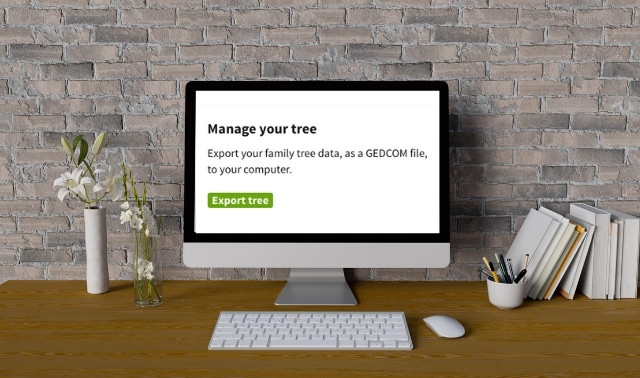
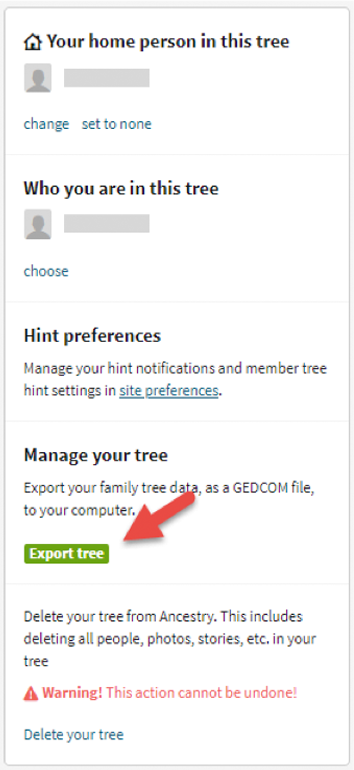
Whorl downwardly on the page to where it says Manage Your Tree: click the button that says Consign Tree, as shown here.
v. Beginnings.com will generate a GEDCOM file
Be patient while Beginnings.com generates a GEDCOM file from your tree data. GEDCOM files are universal file types that can exist read by any family tree software or spider web platform. (Reunion software requires a little extra work.)
6. Click light-green push
In one case your GEDCOM file is ready, a green push button will appear labeled Download Your GEDCOM file. Click to start downloading. (You can also click on the Download Tips text if you need some assist.)
7. Discover in your computer'southward Downloads file
Once the file is downloaded to your estimator, right-click on it to see it in your Downloads binder. Rename it with a more useful name ("Johnson family unit tree from Beginnings") and move information technology to your genealogy files on your computer and so yous can easily find it again.
Sunny Jane Morton
Return to acme
How to Export Your Family Tree GEDCOM Multimedia Files from RootsMagic
Sharing your RootsMagic family unit tree with another researcher is piece of cake: But select Consign from the File menu to create a GEDCOM file that will work with most genealogy software. Only remember: A GEDCOM file can include links to photos and certificate images, but it doesn't include the bodily multimedia files. You have to transport them separately forth with the GEDCOM file.
If you lot create a GEDCOM file with just one branch of your family tree, yous probably want to include only the associated pictures and certificate images, non all the multimedia files for your whole family unit tree. 1 mode to do that in RootsMagic is to create a Shareable CD for the same branch of your family. That will put copies of only the epitome files you need in a divide folder. So you tin share that folder along with the GEDCOM file. Here'south how:
1. Open your family file and select Export from the File card.
If you don't want to share your whole file, look under People to Export and click Select from List. And so find the person whose family, ancestors or descendants you want to share. To jump to the person's name, type it with the surname outset, like this: Morgan, Thomas. Or click the Find button to search on the surname, given names, appointment of birth and more than. The Family Members pane on the correct shows the highlighted person's parents and siblings. To navigate to one of those relatives, highlight a name and click on Go to Selected Person. In one case yous observe the right 1, select the name by clicking the box beside it.
2. Click the Mark Group button to select relatives of the starting person.
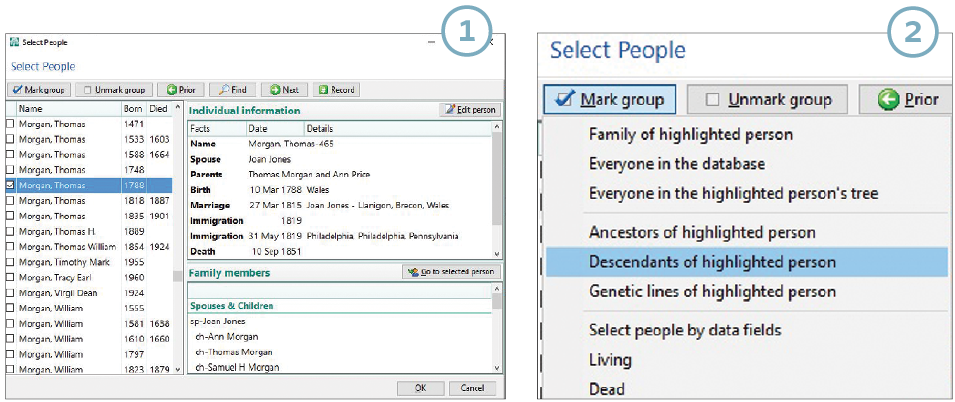
You lot can select just that person'southward family or specify how many generations of ancestors or descendants to include. If you select ancestors, you can also include their other descendants for a certain number of generations. Selecting collateral lines includes everyone linked past blood or union for a specified number of generations. Yous can mark multiple groups, such as ancestors and descendants in different branches of your family. Once you've marked everyone you want to include in the GEDCOM file, click OK.
3. Select the information, such as notes and sources, you lot want to include.
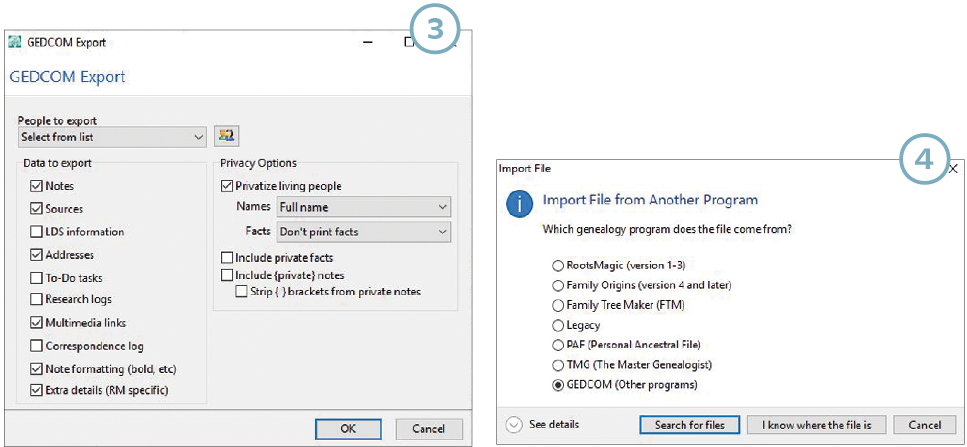
You likewise tin specify information to include on living people, such as full names, facts, individual notes and private facts. Click OK to create the GEDCOM file, give it a proper noun and select the binder on your computer where you want to save it. Select Close from the File menu to shut the family file.
iv. Now y'all'll create a new RootsMagic file from the GEDCOM file.
Select Import from the File menu and then GEDCOM. Click "I know where the file is" and navigate to it on your computer. Select the file and click Open. Give the new RootsMagic file a name (such equally "Smith Tree 2") and specify the binder where you'll save it.
5. At present, make a Shareable CD from the new RootsMagic file.
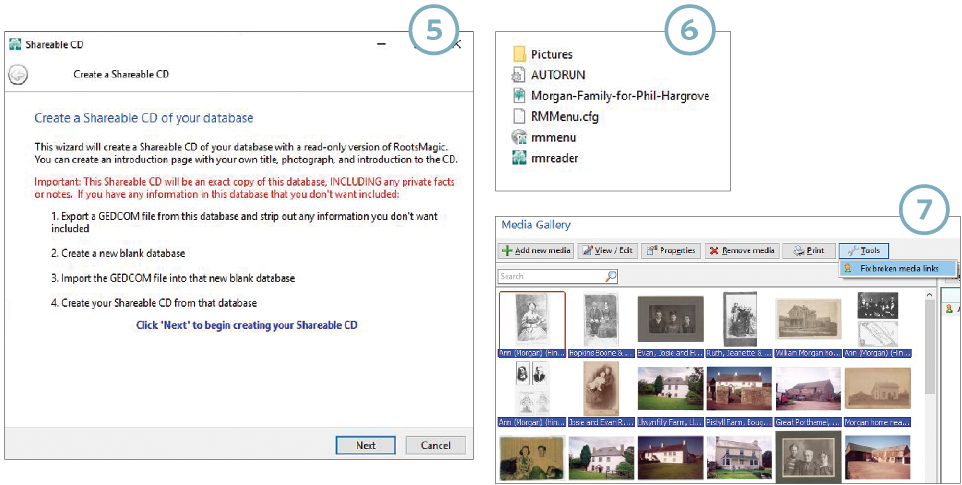
Open the family file you just created. Select Create a Shareable CD from the Tools card and click Next. You can skip the championship, introduction and photo options and click Next. Skip the contact information, too, and click Next again. A window will pop upward that says, "Shareable CD is ready to fire. The files for your shareable CD accept been created in the following binder … " Your CD files volition be saved in a folder chosen RMShareableCD in the same folder that holds your RootsMagic family unit file. Click on "I will burn it later."
6. The Shareable CD files include your family file and pictures, along with a read-only version of RootsMagic.
This lets you share the files with someone who doesn't have genealogy software. For now, since you lot're sharing your family file for utilise with a genealogy program, the only files you demand are the ones in the Pictures folder. Send that binder and the GEDCOM file to the other researcher attached to an email or on a CD or DVD.
7. The files' recipient should import the GEDCOM file into a new family file in his genealogy software.
For example, using RootsMagic, select Import from the File card. Copy the Pictures folder to his difficult bulldoze. To remap the paths in his family file to the pictures, he should select Media Gallery from the Lists Bill of fare and and so Fix Broken Links from the Tools bill of fare. When information technology's done, the links to photos and document images in the family unit file should work.
A version of this commodity appeared in the September 2016 upshot of Family Tree Magazine.
Return to top

The best genealogy software program meets the largest genealogy website. Acquire how to sync RootsMagic with your Ancestry.com family tree.
Go Your Complimentary Essential Genealogy Inquiry Forms
Sign upward for the Family Tree Newsletter and receive 10 research forms equally a special thanks!
Get Your Free Genealogy Forms
DOWNLOAD HERE
Posted by: rodneyincesubtern.blogspot.com
Post a Comment